Published on
June 27, 2024
by
Julia Merkus, MA.
Revised on
November 4, 2025
Hers is a third-person singular feminine possessive pronoun. It’s sometimes written as “her’s”—with an apostrophe—but this spelling is incorrect.
Possession is typically indicated by adding ’s to a word, but possessive pronouns are an exception to this rule. This means that “her’s” is always incorrect.
This is also true for other possessive pronouns, such as ours and theirs. The Quillbot Grammar Checker will fix this and other common mistakes automatically.
Examples: Hers and her’s in a sentence
I forgot my charger, but maybe I can borrow her’s.
Forty is sometimes misspelled as “fourty”—probably because 4 is spelled as “four”—but “fourty” is not a real word. This is also true when “forty” is used as part of a larger number, such as “forty-two” or “two-hundred-forty.” Quillbot’s grammar check tool will fix this and other common mistakes automatically.
Published on
June 27, 2024
by
Julia Merkus, MA.
Revised on
June 10, 2026
At your earliest convenience is a phrase commonly used at the end of a professional email to request someone to do something as soon as reasonably possible.
The phrase is typically considered professional and polite, but it’s not specific and might cause confusion or miscommunication. In some cases, it’s better to use one of our three alternatives to end an email to make sure the other person understands the level of urgency.
Published on
June 27, 2024
by
Julia Merkus, MA.
Revised on
November 5, 2025
Into and in to are pronounced the same, but they have different grammatical uses.
Into (without space) is a preposition that describes insertion, collision, transformation, or entry. It is also used to express that someone is involved with or interested in something.
In to (with space) is a combination of the two prepositions “in” and “to.” These words are kept separate when they are not connected, such as when “in” is part of a phrasal verb (e.g., “the teacher stepped in to break up the fight”).
Examples: Into in a sentence
Examples: In to in a sentence
Sorry, I’m not into men!
The criminal was turned in to the police by his own mom!
Luke quickly raninto the bathroom before the meeting.
I was just checking in to see how you’re doing.
The artist put a lot of thought into each brushstroke of the masterpiece.
Do you all want to chip in to buy a gift for Samuel?
Published on
June 27, 2024
by
Julia Merkus, MA.
Revised on
November 4, 2025
Beck and call is the correct spelling of the phrase that’s part of the expression “to be at someone’s beck and call,” which means “to be ready to follow someone’s commands.”
Beckon call is a common misspelling of the phrase and should be avoided.
Examples: Beck and call or beckon call in a sentence
Damien is at the beckon call of his mom.
Damien is at the beck and call of his mom.
You don’t have to be at my beckon call.
You don’t have to be at my beck and call.
The nounbeck is related to the verbbeckon, but they have different meanings and can’t be used as synonyms. Beck is typically only used as part of the expression beck and call.
Published on
June 27, 2024
by
Julia Merkus, MA.
Revised on
October 29, 2025
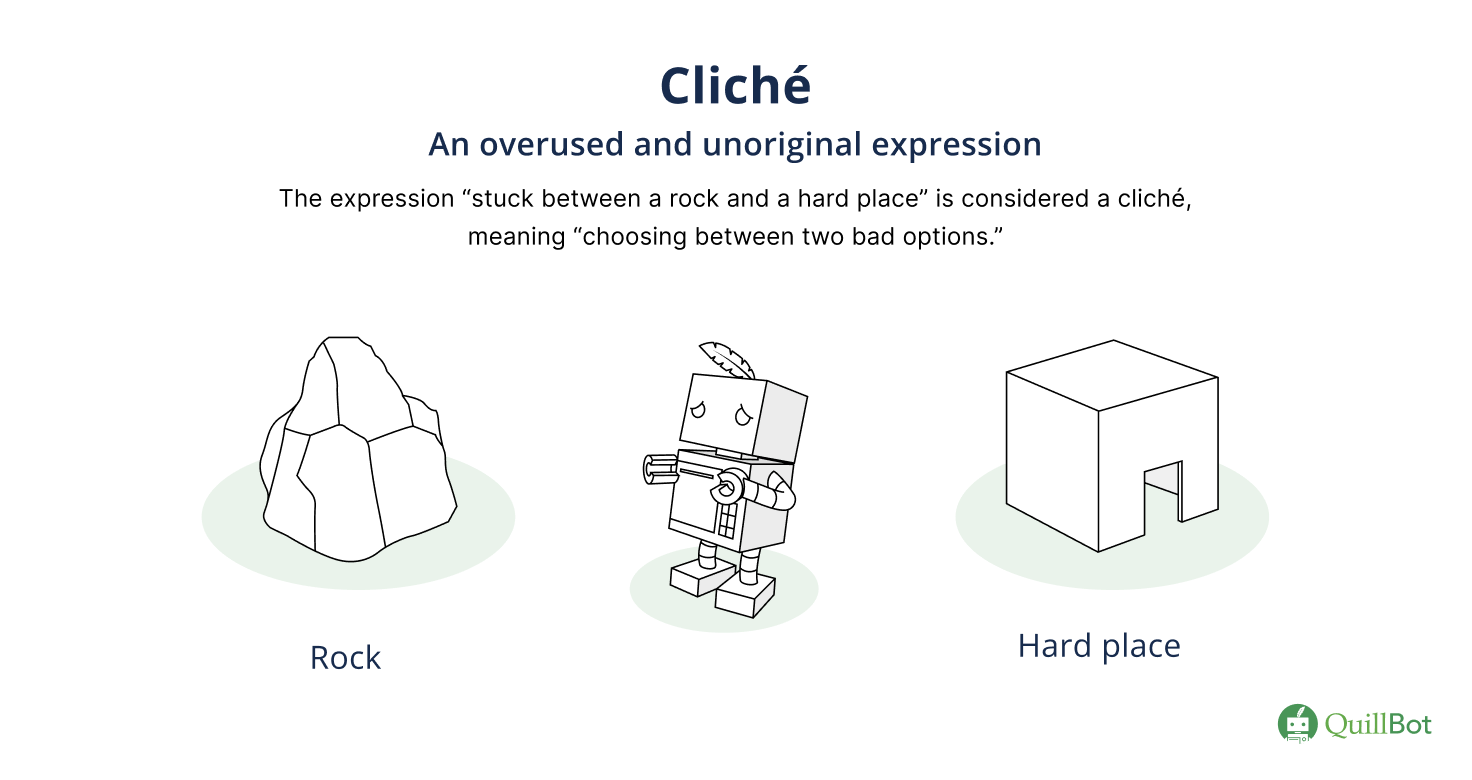
A cliché is an overused and unoriginal expression. For example, when having to decide between two unfavorable options, it’s common to say “caught between a rock and a hard place.”
The word cliché functions as a noun (e.g., “I removed all the clichés from my writing”). While some dictionaries recognize it as an adjective (e.g., “The movie had a cliché storyline”), others list clichéd as the adjective form (e.g., “He had a clichéd perspective”).
Examples of ClichesAvoid it like the plague.
Better late than never.
Published on
June 25, 2024
by
Julia Merkus, MA.
Revised on
November 5, 2025
The difference between “sale” and “sell” is that “sale” only functions as a noun, whereas “sell” can be used as both a noun and a verb.
“Sale” primarily refers to the event of trading goods and services for money (e.g., “All my art work is for sale”).
“Sell,” on the other hand, conveys the action of exchanging goods and services for monetary payment (e.g., “I will sell you this bike”). “Sell” can also be used as a noun to refer to the act of selling something, but this is less common (e.g., “That’s a hard sell”).
Published on
June 14, 2024
by
Julia Merkus, MA.
Revised on
November 26, 2025
Systematic sampling, also known as systematic random sampling, is a probability sampling technique that involves selecting every nth element from the population, where n is the predetermined sampling interval.
The sampling method provides you with a representative sample of a population as long as the order of the population is random or near-random (e.g., alphabetically ordered). The data collected from this sample can be used to draw conclusions about your entire research population.
Systematic sampling exampleA university wants to study the academic performance of students in a particular course. The course has 500 students, and the university wants to select a sample of 50 students to conduct a survey about their learning experiences.
To conduct the survey, the university decides to use systematic sampling. They start by creating a list of all the students in the course, numbered from 1 to 500.
To select the sample, they decide to use a sampling interval of 10. This means they will select every 10th student from the list until they’ve reached their desired sample size.
Published on
June 14, 2024
by
Julia Merkus, MA.
Revised on
November 26, 2025
Internal validity refers to the extent to which a research study’s design and methods minimize the likelihood of alternative explanations for the observed effect between variables.
In other words, internal validity addresses the question: “Is the observed effect or relationship likely due to the independent variable (the variable being manipulated) and not due to other factors?”
A high level of internal validity means that the study’s conclusions are likely to be reliable. It’s one of the most important types of validity in research.
Internal validity exampleA fitness instructor wants to investigate whether a new exercise program improves cognitive function in adults. The study consists of 20 participants, who are randomly assigned to either a treatment group or a control group.
The treatment group participates in the new exercise program for 3 months
The control group does not participate in any exercise.
The participants’ cognitive function is assessed using a standardized test at the beginning and end of the 3-month period.
However, during the 3-month period, the participants are also encouraged to eat a healthy diet as part of their overall health and wellness. The researcher doesn’t control for this extraneous variable, so it’s possible that any changes in cognitive function are due to the diet rather than the exercise program. The study has low internal validity
TipWhile not a substitute for expert opinion, generative AI tools like Quillbot’s AI Chat can help you think through possible threats to internal validity in your own or others’ research.
Published on
June 13, 2024
by
Julia Merkus, MA.
Revised on
November 26, 2025
Face validity is a type of validity that refers to the extent to which a research instrument, such as a survey, questionnaire, or test, appears to measure what it is supposed to measure.
In other words, face validity is concerned with whether the instrument looks like it is measuring what it claims to measure.
Face validity exampleYou’re interested in measuring participants’ weight in a medical trial.
You have thought of two methods of recording weight:
Participants stand on a scale, and you write down the number.
Participants self-report what they eat, and you estimate their weight.
Both methods have a very different level of face validity:
The first technique has high face validity because a scale is an appropriate instrument to measure weight.
The second technique has low face validity because you can’t deduce weight from information on what someone eats.
Face validity is typically evaluated by experts in the field, such as researchers or academics who have knowledge about the topic being studied. They review the instrument and assess whether it appears to measure the concepts or variables it claims to measure.