As the new school year approaches, teachers are setting up their classrooms and searching for fresh back-to-school bulletin board ideas. The first bulletin board of the year is students’ first impression of the classroom culture. In a world where design trends change quickly, today’s classroom displays need to feel both welcoming and visually engaging.
Creating a standout bulletin board comes with challenges. The cost of pre-made kits can add up, and scrolling through countless online designs can be overwhelming during an already busy back-to-school season. That’s why teachers need creative back-to-school bulletin board ideas that are affordable and easy to customize.
This article features 15 back-to-school bulletin board ideas to help teachers create eye-catching displays that engage students from Day 1. Use Quillbot’s free Image Generator to personalize your favorite designs with custom letters, images, and visuals that reflect your teaching style and design preferences.
Key takeaways
Back-to-school bulletin boards help teachers make a positive first impression and get students excited about learning.
The best back-to-school bulletin board ideas combine a clear message, bold visuals, and simple designs that are easy for students to read.
Back-to-school bulletin board ideas include themes ranging from sunshine and space to books to wild animals and retro designs.
The list of 5-letter words that start with H is full of familiar favorites and hidden gems. While words like “happy,” “heart,” and “human” are common in everyday conversation, words like “hygge” and “haint” can help you learn more about the world. The 5-letter words beginning with H are also helpful for Wordle, Words With Friends (WWF), and similar games.
Whether you’re trying to solve a tricky puzzle, expand your vocabulary, or find a word that fits a specific pattern, this collection of 80+ words has you covered.
If you’re looking for a specific type of 5-letter word that starts with H, Quillbot’s AI Chat can help you out.
Key takeaways
5-letter words that start with H include a mix of common everyday vocabulary and less familiar terms that are useful for communication and word games.
High-value letters like Z and X make certain H words especially effective for maximizing points in Scrabble and Words With Friends.
Grouping 5-letter H words by their ending letter makes it easier to find words that fit specific Wordle patterns and other word puzzles.
Learning advanced H words can expand your vocabulary while introducing interesting concepts from mythology, culture, science, and history.
The 5-letter words that start with G include a range of options for word games and vocabulary lists. Words like “grate” and “glare” can help you eliminate possibilities early in a Wordle game, and words like “gizmo” and “graze” can boost your score in a game of Scrabble or Words With Friends (WWF). The list also includes everyday terms, like “great” and “group,” and advanced vocabulary, like “gaffe” and “glyph.”
This guide includes an alphabetical list of more than 130 options along with tips for word games and definitions (with example sentences) of the most advanced 5-letter words that start with the letter G.
With Quillbot’s AI Chat, you can quickly and easily generate word lists for any theme, letter count, or part of speech.
Key takeaways
Find more than 130 5-letter words that start with G, organized alphabetically and by ending letter for Wordle, Scrabble, Words With Friends (WWF), and crossword puzzles.
Improve your Wordle strategy with high-value starting words, common letter patterns, and tips for choosing your next guess when the answer begins with G.
Boost your Scrabble and WWF scores by learning which 5-letter G words earn the most points, including options with high-value letters like Z, Y, and K.
Expand your vocabulary with definitions and example sentences for advanced 5-letter G words, such as “gamut” and “guise.”
Back-to-school coloring pages serve many purposes beyond keeping students busy and filling extra time. When done right, they provide valuable insight into students’ interests, developmental skills, and readiness for learning as they settle into new routines. Teachers can use them in first-day-of-school lesson plans to assess fine motor skills, handwriting, and early literacy on the first days of school.
Whether you’re looking for first-day-of-school coloring pages, all-about-me coloring pages, or similar printables for students in pre-K to 2nd grade, the 15 coloring pages below offer a range of fun and engaging back-to-school images.
Quillbot’s free Image Generator can help you create custom coloring pages that are perfectly suited to your students’ needs.
Key takeaways
Back-to-school coloring pages do more than keep students busy. They help teachers assess fine motor skills, handwriting, early literacy, and school readiness in a low-pressure, engaging way.
Choose activities that match your students’ developmental goals. From tracing and name writing to letter recognition, counting, and listening skills, the right coloring pages can support meaningful first-week observations.
Find printable coloring pages for every early elementary grade. Explore 15 free options for Pre-K through 2nd grade, including self-portraits, all-about-me pages, classroom activities, and back-to-school themes.
Create custom coloring pages when you need something specific. Use Quillbot’s free Image Generator to design printables tailored to your classroom, lessons, or students’ needs.
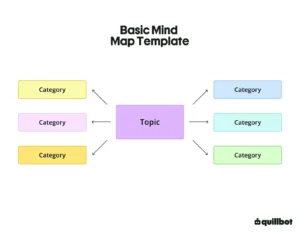
If you’ve ever zoned out while reading a textbook chapter or struggled with writer’s block, mind mapping might be your new favorite study tool.
Like an outline, a mind map organizes information into categories and supporting details, but it shows how ideas connect instead of presenting them in a linear format. Mind maps save time and boost success in two ways:
Studying a textbook chapter: Mapping the topic, section headings, and key terms encourages active learning and helps you remember information more effectively.
Writing an essay: Planning your main idea, body paragraph topics, and supporting details gives you a clear roadmap before you start drafting.
Whether you’re studying for an exam or planning a paper, you can create a mind map with pen and paper or an online design tool, and it can be as simple or detailed as you need.
In this guide, you’ll learn how to create a mind map for studying and writing, explore examples, and discover templates that you can download for free.
If you’d like to create your own mind map template from scratch, Quillbot’s Image Generator is a fast and free option.
Basic mind map template
Key takeaways
A mind map is a visual way to organize information by placing a main topic in the center and branching out to related categories and supporting details.
Mind maps help you study more effectively because creating them is a form of active learning that makes information easier to understand and remember.
Mind maps can improve your writing process by helping you brainstorm ideas, organize body paragraphs, and overcome writer’s block before you start drafting.
Creating a mind map is simple: start with a central idea, add the main categories, and branch out with key details, examples, or evidence.
Words that start with D include a wide range of options, from simple 3-letter words, like “day” and “dog,” to advanced vocabulary, like “doppelganger” and “dubious.”
This guide covers the full range, with more than 500 words, organized by letter count and part of speech. You’ll also discover tips for Wordle, Scrabble, and Words With Friends (WWF) along with a curated list of fun and rare words that start with D.
TipWorking on lesson plans with words that start with D? Quillbot’s Word Cloud Generator is a quick and easy way to display vocabulary and spelling lists.
Words that start with D from Quillbot’s Word Cloud Generator
Key takeaways
Words that start with D include common terms like “dig” and “dog” and rare vocabulary, like “doppelganger.”
The best words that start with D for Wordle include “daisy” and “daily” because they have multiple vowels and common consonants.
Studying nouns, adjectives, and verbs that start with D can improve vocabulary and communication.
Some of the most intriguing words that start with D include “decoy” and “decoupage.”
Whether you’re exploring 5-letter words that start with D for word games or vocabulary, there are dozens of options. The most common choices include “dance,” “dress,” “drink,” “dream,” and “drive.” Advanced 5-letter D words, like “dicot” and “divan,” are ideal for expanding your vocabulary and discovering new word game strategies.
This guide includes a comprehensive list of over 120 5-letter words that start with D along with tips for Wordle, Scrabble, and Words With Friends (WWF). You’ll also find a curated list of advanced 5-letter D words with definitions and example sentences.
Looking for a specific type of 5-letter word that starts with D? Try Quillbot’s free AI Chat. It can show you lists for any theme or category you need.
Key takeaways
There are over 120 5-letter words that start with D, including “daisy,” “dream,” and “duvet.”
The best options for Wordle include “daily,” “douse,” and several others with multiple vowels and common consonants.
High-scoring picks for Scrabble and WWF include “ditzy” and several more.
Advanced 5-letter words that start with D include “delve” and “divan.”
If you’ve ever opened a writing assignment and wondered, “What’s an MLA essay?” you’re not alone. MLA format isn’t about what you write in your essay but rather how your essay looks on the page. Even though MLA style involves lots of little details, it gets easier with practice.
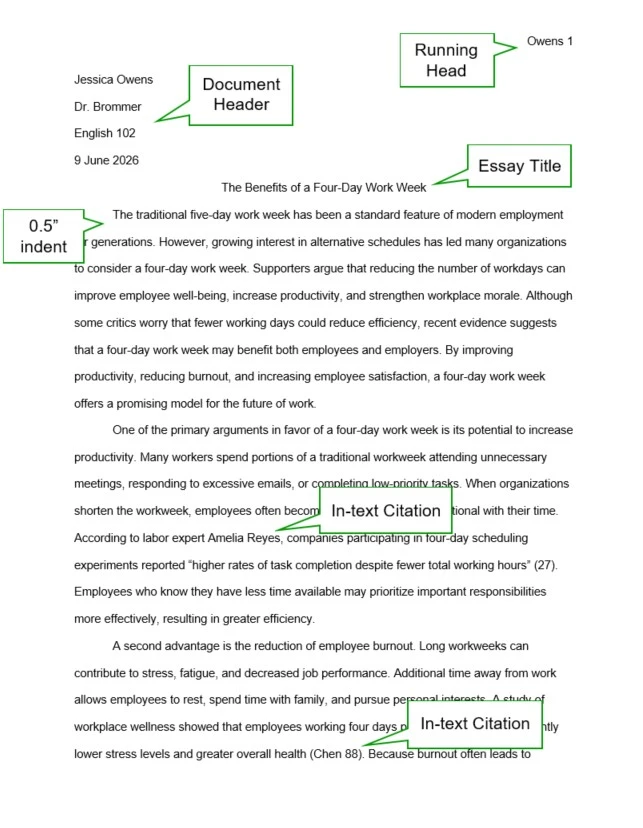
An MLA format essay follows specific guidelines for everything from 1-inch margins and double spacing to a document header, running head, and citations. All of these guidelines are based on the MLA Handbook (ninth edition). Once you’re familiar with these requirements, setting up an MLA paper becomes a straightforward process.
Whether you write your essays in Microsoft Word or Google Docs, this guide shows you exactly what steps to follow, with sample MLA pages and a free MLA template.
And when you’re ready to cite sources, Quillbot’s free Citation Generator helps you create a flawless works cited page in just a few clicks.
MLA essay format example
Key takeaways
MLA format standardizes how your essay looks, including page layout, citations, and the works cited page.
Use 1-inch margins, double spacing, a readable 11–12 point font, and a running head on every page.
MLA papers typically include a document header instead of a separate title page.
This guide walks you through every step of MLA essay format in Google Docs and Microsoft Word, with examples and a free template.
When a single exam can make or break your final grade, you need a variety of powerful yet practical study techniques.
The best study techniques for exams are far more effective than rereading your textbook for hours at a time. They support the three main stages of the memory process:
Encoding new information by organizing and connecting ideas in ways that make them easier to understand and remember
Storing information in long-term memory by spacing out and scheduling study sessions to improve retention and avoid cramming
Retrieving information through active recall, which helps you practice pulling information from memory during the actual test
To help you incorporate all of these elements into your study routine (and ace your exams), this guide covers 10 science-backed study techniques, including mind mapping, Cornell notes, and distributed practice.
Quillbot’s AI Chat is a fast and free resource for your study needs. You can prompt it to generate flashcard ideas, ask it about the concepts you’re studying, and more.
Key takeaways
The most effective study techniques for exams enhance the three stages of the learning process: encoding, storage, and retrieval.
Techniques like mind mapping and chunking help your brain encode information in a way that makes it easier to understand and remember.
Spacing out study sessions and mixing topics strategically can significantly improve your brain’s ability to store information in long-term memory.
Active recall strategies, like the Leitner flashcard system, help you practice retrieving details from memory while you’re taking a test.
Writing an essay in APA style means following a specific set of formatting rules that affect how everything looks on the page.
APA essay format includes specific rules for everything from the font and title page to the headings and reference page. Although it seems like a lot at first, setting up a paper in APA style is easier when you go step by step. Once the APA formatting is in place, you can focus on developing your ideas.
This guide breaks down the APA essay format for student papers in simple steps. You’ll learn how to set up your document in Microsoft Word or Google Docs with examples and a free template to help you follow APA formatting rules with confidence and ease.
Need help citing your sources? Use Quillbot’s APA Citation Generator to quickly create accurate citations.
Key takeaways
APA style uses specific formatting requirements for student papers, including rules for fonts, margins, spacing, page numbers, headings, and reference pages.
A well-formatted APA essay typically includes a title page, the main body of the paper, and a reference page, each with its own formatting conventions.
APA citations consist of both in-text citations and reference entries, with formatting that varies depending on the source type and citation style used.
Step-by-step instructions, examples, and a free template can make it easier to create an APA-formatted essay in Microsoft Word or Google Docs.
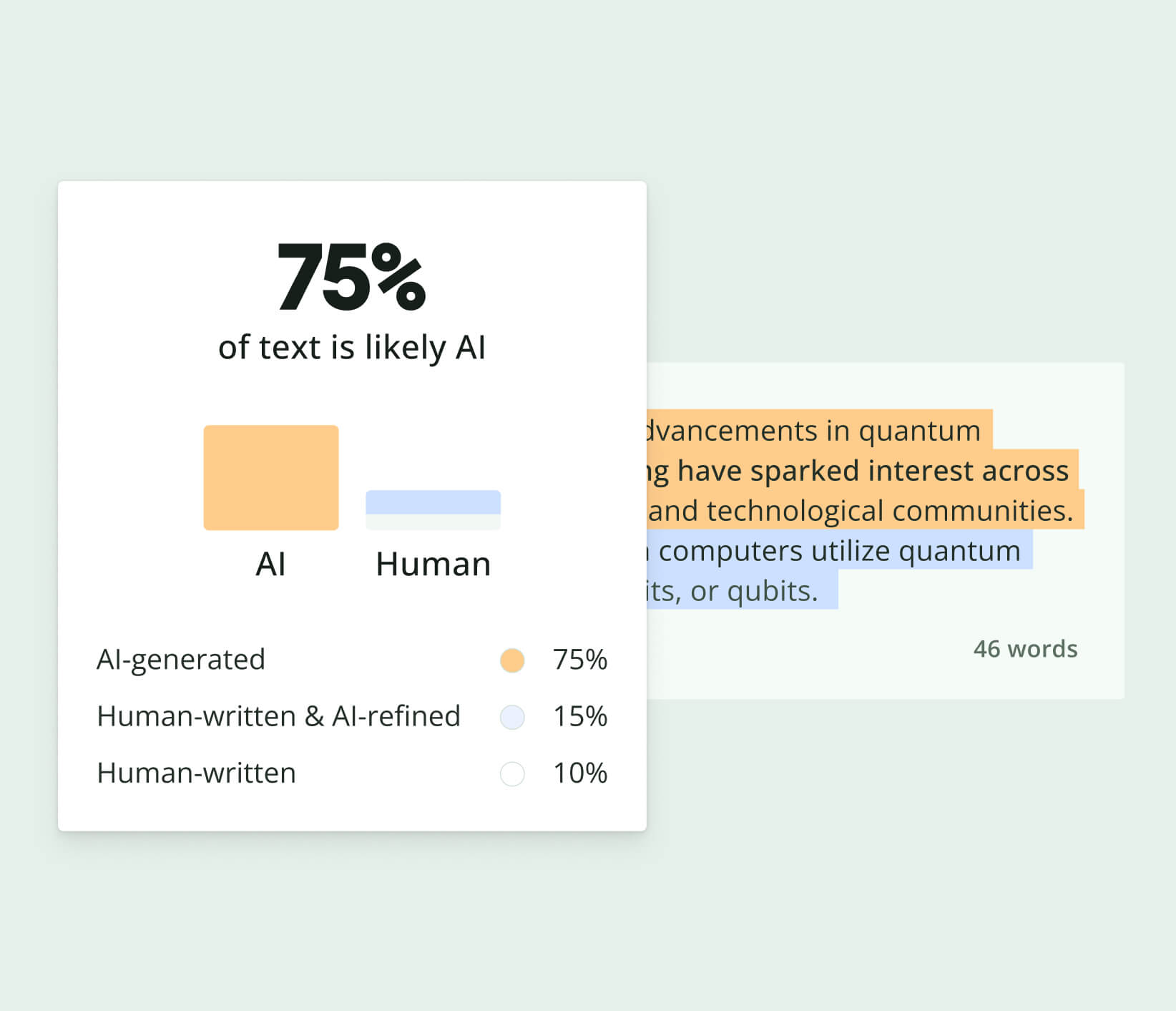
Work smarter with Quillbot’s AI Detector. Quickly assess whether text appears
AI-generated or human-written before publishing or submitting your content.
Work smarter with Quillbot’s AI Detector. Quickly assess whether text appears
AI-generated or human-written before publishing or submitting your content.